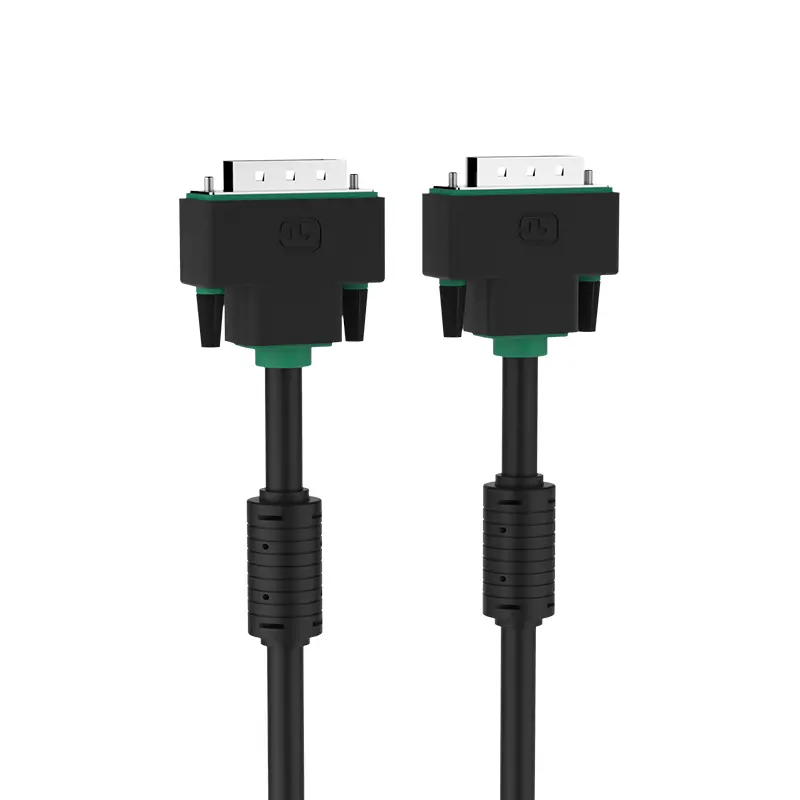
What is the difference between a VGA cable and an RCA audio cable?
A VGA cable is designed to transmit analog video signals from a source device (like a computer) to a display (like a monitor or projector). An RCA audio cable, typically consisting of red and white connectors, is designed to transfer analog stereo audio signals between audio components.
What does the "(3+6)" specification in a VGA cable represent?
The "(3+6)" specification indicates the internal wiring structure of the VGA cable. It contains 3 coaxial lines that carry the primary RGB (Red, Green, Blue) video color signals, and 6 standard data sync wires to support functions like DDC (Display Data Channel), ensuring correct resolution auto-detection.
Can I connect a VGA video output directly to an RCA audio input?
No, because VGA carries only video signals, while RCA audio cables carry only audio signals. If you want to connect a device with a VGA port to a system requiring RCA inputs, you must use an active converter that extracts and converts signals, often splitting them into separate VGA (or HDMI) video and RCA audio channels.
What are the common applications for a 2 x RCA Audio cable?
A 2 x RCA audio cable is widely used to connect stereo audio outputs from devices like DVD players, gaming consoles, media players, or TV boxes to external sound systems, AV receivers, amplifiers, or active speakers.
How does cable shielding affect the quality of VGA and RCA connections?
High-quality shielding protects the analog signals within VGA and RCA cables from electromagnetic interference (EMI) and radio frequency interference (RFI). Double shielding (foil and braid) prevents ghosting or fuzziness in VGA video and eliminates static hums or buzzing in RCA audio.
What is the maximum effective length for analog VGA and RCA cables?
Analog signals degrade over distance. Generally, standard VGA cables perform best under 15 meters (50 feet), and RCA audio cables should ideally be kept under 10 meters (30 feet) to prevent noticeable signal attenuation and noise introduction unless signal boosters are utilized.
 Taichang Electronic