Q
What is the primary difference between a VGA cable and a DVI cable?
VGA (Video Graphics Array) carries analog video signals, whereas DVI (Digital Visual Interface) can transmit both digital and analog video signals. DVI generally provides a sharper and clearer image quality compared to VGA, particularly at higher resolutions.
Q
What does "3+9" mean in a VGA cable specification?
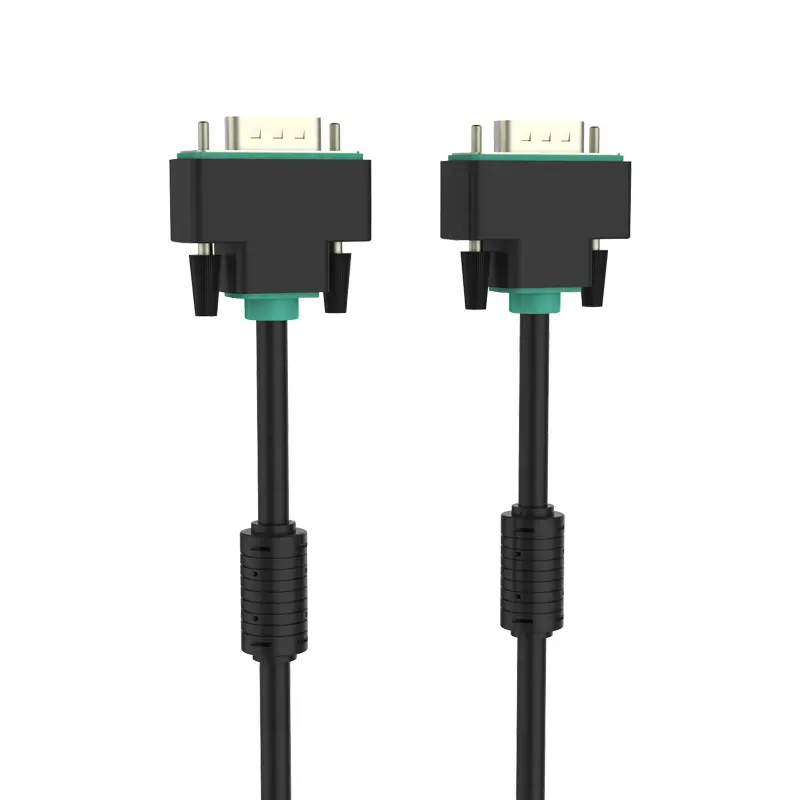
A "3+9" specification refers to the internal wiring configuration. It features 3 coaxial lines that transmit primary color signals (Red, Green, and Blue) and 9 additional data lines for synchronization, grounding, and DDC (Display Data Channel) communication, which ensures optimal resolution settings and signal integrity.
Q
Can a VGA to DVI cable support audio transmission?
No, both VGA and DVI connections are designed to carry video signals only. To transmit audio, you will need a separate audio solution, such as a 3.5mm auxiliary cable or a dedicated optical audio cable.
Q
Are VGA to DVI cables compatible with all DVI ports?
These cables are compatible with DVI-I (integrated digital and analog) and DVI-A (analog only) ports. They are not compatible with DVI-D (digital only) ports unless an active signal converter is used to translate the analog VGA signal into a digital DVI signal.
Q
What is the recommended maximum resolution for a VGA connection?
Although VGA can support higher resolutions under ideal conditions, it is generally recommended for resolutions up to 1920x1080 (1080p Full HD) to avoid signal degradation, ghosting, or interference over longer cable runs.
 Taichang Electronic